Table Of Content

It is therefore helpful to introduce a second differentiation in the field that, following Bourdieu (1975, p. 103), is based on the differences between the expected profits from these strategies. Here a distinction can be made between an autonomous and a heteronomous pole of the field, i.e., between the purest, most “disinterested” positions and the most “temporal” positions that are more pervious to the heteronomous logic of social hierarchies outside the scientific field. Of course, this difference is a matter of degree, as even the works produced at the most heteronomous positions still have to adhere to the standards of the scientific field to be seen as legitimate. But within each discipline this dimension captures the difference between agents predominantly engaged in fundamental, scholarly work—“production solely for the producers”—and agents more involved in applied lines of research. The main component of the expected profit from innovation in the first case is scientific, whereas in the second case the balance tends to shift towards more temporal profits. Innovations can be radical or revolutionary in a rational sense, but they tend to originate from questions raised by the orthodoxy of the field.
Materials and methods
Despite the strengths of mixed-methods research but there is not much of it in nursing and other fields [7]. A recent review paper shows that the prevalence of mixed-methods studies in nursing was only 1.9% [7]. Similarly, a systematic review synthesised a total of 20 papers [16], and 16 papers [17] on nursing-related research paper among these only one mixed-methods paper was identified. Worse, a further two mixed-methods review recently revealed that out of 48 [18,19] synthesised nursing research papers, not one single mixed-methods paper was identified.
Examples of Mixed Methods Research
This principle allows us to make a distinction between, respectively, the dominant and dominated factions in a field. However, in mature fields all agents—dominant and dominated—share an understanding of what is at stake in the field and tend to accept its principle of hierarchization. Simultaneity (“Simultanität”) forms the basis of the distinction between concurrent and sequential designs.
Strengths of mixed methods research
The assessment consisted of two parts, which were (1) self-perceived confidence and (2) self-perceived awareness. All items were designed using a 5-point Likert scale, where 1 being ‘strongly disagree’ and 5 being ‘strongly agree’. The second theme discussed in a large number of contributions is the role epistemology plays in MMR. In a sense, epistemology provides the lifeblood for MMR in that methods in MMR are mainly seen in epistemological terms. This interpretation of methods is at the core of the knowledge claim of MMR practitioners, i.e., that the mixing of methods means mixing broad, different ways of knowing, which leads to better knowledge of the research object. It is also part of the identity that MMR consciously assumes, and that serves to set it apart from previous, more practical attempts to combine methods.
Questionnaire – Definition, Types, and Examples
This study included postgraduate students from Years 1 to 3 in the Residency Training Program in Advanced General Dentistry at Mahidol University Faculty of Dentistry, enrolled during the academic year 2022. They were also required to at least complete the first semester to be eligible for this research to ensure familiarity with comprehensive dental care. However, they were excluded if they had previous involvement in the pilot testing of the gamified online role-play or if they were not fluent in the Thai language. The sample size was determined using a formula for two dependent samples (comparing means)37. To detect a difference in self-perceived confidence and awareness between pre- and post-assessments at a power of 90% and a level of statistical significance of 1%, five participants were required.
Theme 2: Learning settings of the gamified online role-play
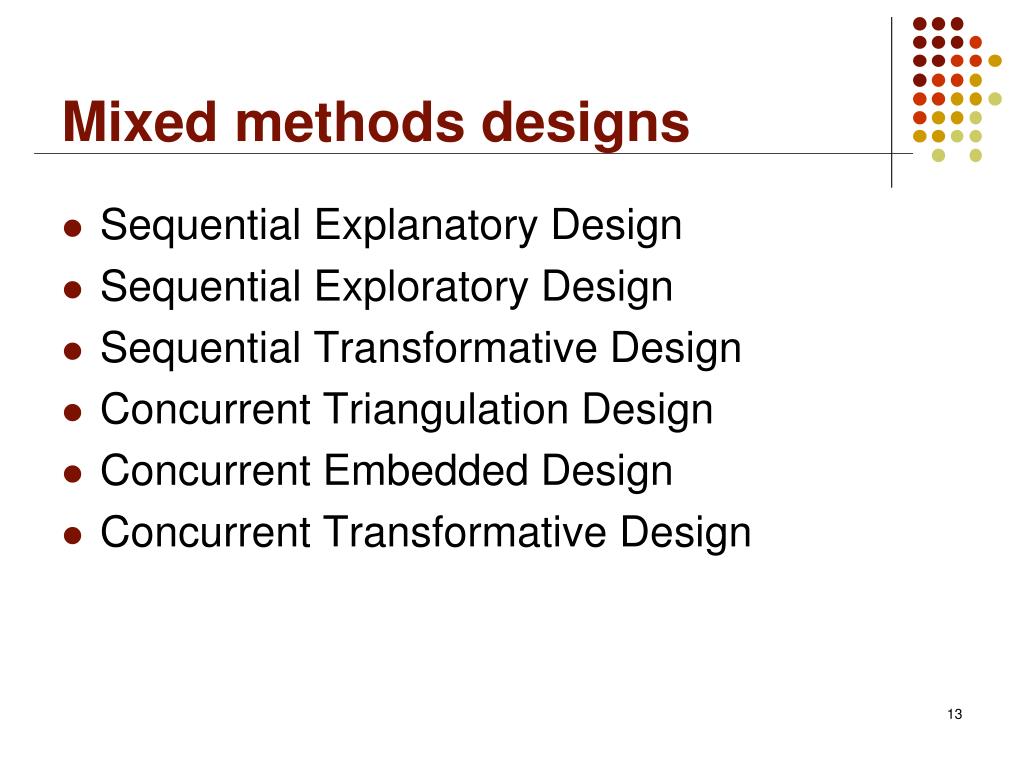
An example of this could be a study that involves forming focus groups with participants who actively develop the research questions and then provide feedback during the data collection and analysis stages. The embedded design is when the quantitative and qualitative data are collected simultaneously, but the qualitative data is embedded within the quantitative data. This design is best used when you want to focus on the quantitative data but still need to understand how the qualitative data further explains it. The convergent parallel design is when data collection and analysis of both quantitative and qualitative data occur simultaneously and are analyzed separately.
The Use of Mixed Methods in Research
First, we showed that there are there are many purposes for which qualitative and quantitative methods, methodologies, and paradigms can be mixed. Inclusion of a purpose in the design name can sometimes provide readers with useful information about the study design, as in, e. There are a number of secondary considerations for researchers to also think about when they design their studies (Johnson and Christensen 2017). Now we list some secondary design issues and questions that should be thoughtfully considered during the construction of a strong mixed methods research design.
What is mixed methods research?
This example nicely illustrates the distinction we made between simultaneity and dependency. On the two aspects of the timing dimension, this study was a concurrent-dependent design answering a set of related research questions. The data collection in this example was conducted simultaneously, and was thus concurrent – the quantitative closed-ended questions were embedded into the qualitative in-depth interviews. It should be clear to the reader that, although much progress has been made in the area of mixed methods design typologies, the problem remains in developing a single typology that is effective in comprehensively listing a set of designs for mixed methods research. This is why we emphasize in this article the importance of learning to build on simple designs and construct one’s own design for one’s research questions. This will often result in a combination or “hybrid” design that goes beyond basic designs found in typologies, and a methodology section that provides much more information than a design name.
The influence of Gamification on medical students' diagnostic decision making and awareness of medical cost: a mixed ... - BMC Medical Education
The influence of Gamification on medical students' diagnostic decision making and awareness of medical cost: a mixed ....
Posted: Sat, 28 Oct 2023 07:00:00 GMT [source]
Thus, the act of mixing methods à la MMR has the paradoxical effect of encouraging a crude black box approach to methods. This is a third problematic characteristic of MMR, because it hinders a detailed study of methods that can lead to a much richer perspective on mixing methods. Thus, the coupling of innovative strategies to specific field positions based on the amount of scientific capital alone is not straightforward.
In addition to communication skills, participants reported that challenges embedded in the role-play allowed them to enhance critical thinking and problem-solving skills, which were a set of skills required to deal with potential problems in the use of teledentistry. The selections that Leech and Creswell make regarding the key actors are based on their close involvement with the “MMR movement.” It is corroborated by a simple analysis of the articles that appeared in the Journal of Mixed Methods Research (JMMR), founded in 2007 as an outlet for MMR. Complexity, then, not only depends on the number of components, but also on the extent to which they depend on each other (e. g., “one approach affects the formulation of the other”). (a) Credibility – refers to suggestions that employing both approaches enhances the integrity of findings. This integration method combines different methods with differing or conflicting results to generate one unified answer. An example of this could be studying how parents interact with their children by conducting interviews and then using a survey to further explore and measure these interactions.
In addition, at the completion of the gamified online role-play, summative feedback provided by instructors could summarize the performance of participants leading to further improvements in the implementation of teledentistry. Most participants suggested that the gamified online role-play in teledentistry should be arranged in the first year of their postgraduate program. This could maximize the effectiveness of online role-play, as they would be able to implement teledentistry for their clinical practice since the beginning of their training. However, some participants suggested that this learning approach could be rearranged in either second or third year of the program. As they already had experience in clinical practice, the gamified online role-play would reinforce their competence in teledentistry. The time allocated for the gamified online role-play in this research was considered as appropriate, as participants believed that a 30-minutes period should be suitable to take information and afterwards give some advice to their patient.
This language is sometimes included in the design name to communicate this characteristic of the study design (e. g., a “quantitatively driven sequential mixed methods design”). The purpose of this article is to help researchers to understand how to design a mixed methods research study. Perhaps the simplest approach is to design is to look at a single book and select one from the few designs included in that book. Here we have shown that one often needs to construct a research design to fit one’s unique research situation and questions.
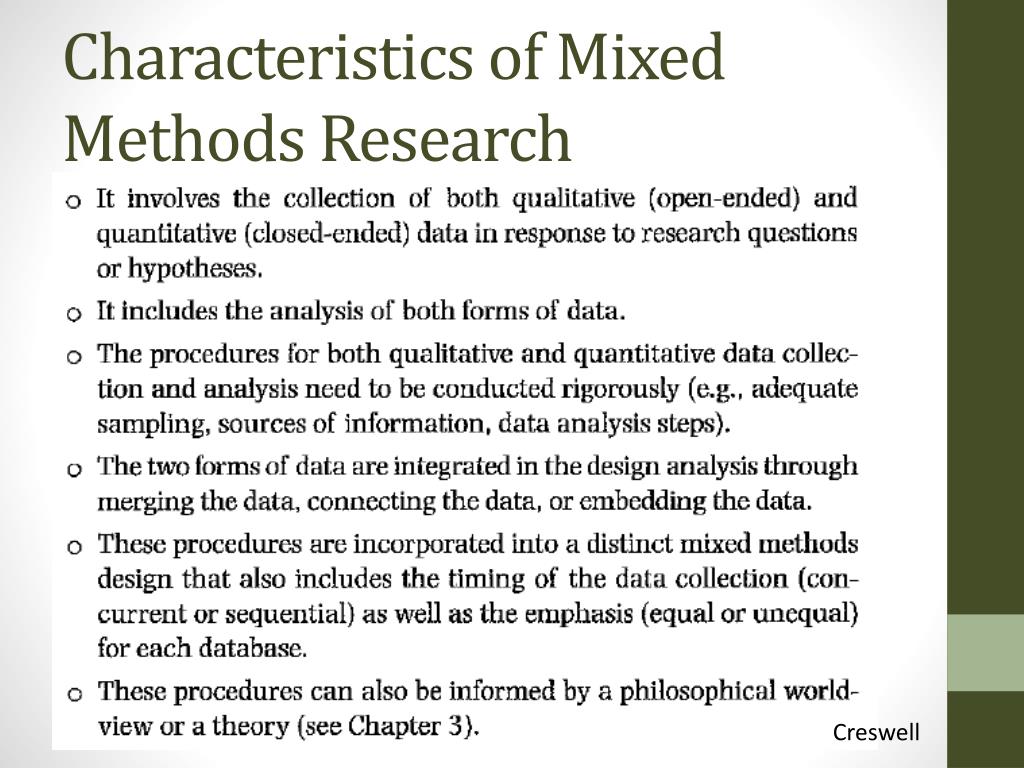
This paper highlights the strengths and weaknesses of mixed-methods approaches as well as some of the common mistakes made by researchers applying mixed-methods for the first time. The second dimension is theoretical drive in the sense that Morse and Niehaus (2009) use this term. That is, will the study have an inductive or a deductive drive, or, we added, a combination of these. Related to this idea is whether one will conduct a qualitatively driven, a quantitatively driven, or an equal-status mixed methods study.




No comments:
Post a Comment